Storefront Glass Door Repair Houston: 7 Common Fixes
May 9, 2026
Commercial door replacement near me when it won’t close
June 22, 2026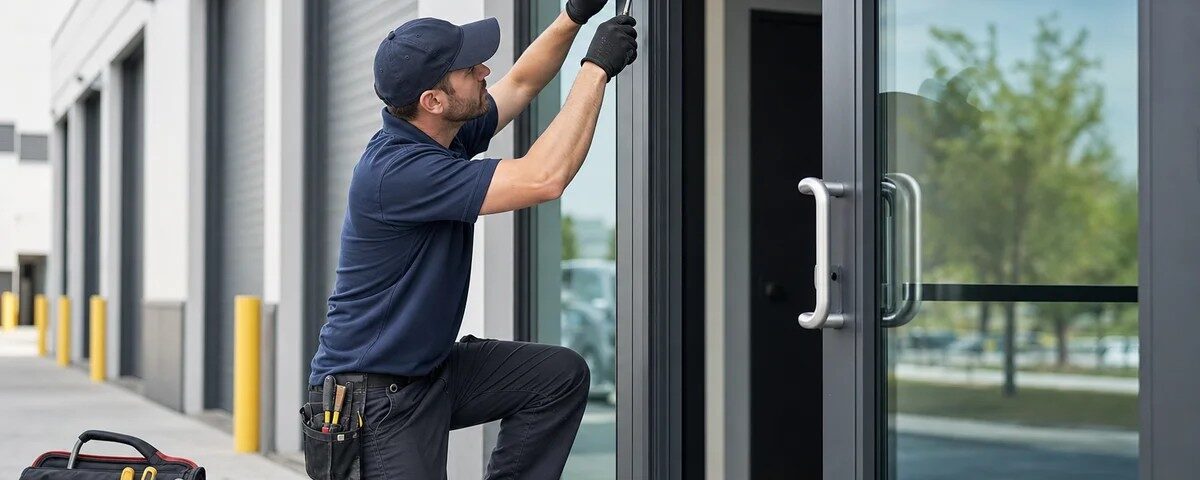
Houston commercial door repair when your entry won’t latch, swings open, or slams shut
Commercial door repair in Houston is the professional work of restoring safe egress, reliable security, and code-compliant operation on high-traffic business doors. Instead of “making it close,” the goal is predictable swing control, proper latching, and hardware that functions the way life-safety and accessibility standards typically expect it to function. When a door is used hundreds of times a day, small misalignments can turn into risk quickly.
The business stakes are usually immediate. A door that won’t lock can leave you exposed after-hours, even if the gap looks minor from the sidewalk. A door that drags or takes too much force to open can trigger ADA accessibility complaints, especially for customers using mobility devices. And when egress hardware fails (like panic hardware that will not release), you are dealing with a life-safety liability, because occupants must be able to exit without special knowledge or tools during an emergency.
- Door won’t latch: usually strike alignment, the latch is hitting the strike plate instead of entering it. If it only latches when you pull the door tight, the closer may also be underpowered or out of adjustment.
- Door slams shut: usually closer valve settings (sweep or latch speed), wind/stack pressure, or a closer that is failing internally.
- Door rubs the threshold: often hinge sag, worn pivots, or frame shift that changes the reveal gap at the bottom corner.
- Panic bar won’t retract: commonly latch mechanism wear, binding, or misalignment between the latch and strike.
What commercial storefront door repair Houston businesses most often need
Most storefront door service calls fall into a few predictable categories, and each one tends to point to a specific root cause. When the symptom is matched to the root cause, it is easier to set expectations for scope and time and avoid the “mystery fix” that comes back a month later.
- Closers: leaking seals, misadjustment, or the wrong spring size for the door weight and usage. Typical scope is a closer swap, arm setup, and valve adjustment, 30 to 60 minutes.
- Hinges and pivots: worn bearings, loose fasteners, or a dropped door that has changed the reveal. Typical scope is re-fastening, shimming, pivot service, and realignment, 45 to 90 minutes.
- Latches and locks: misaligned strikes, worn latchbolts, or a loose storefront lock body. Typical scope is strike relocation or adjustment, tightening, and latch engagement tuning, often paired with door alignment.
- Panic hardware: binding, broken hold-open (dog-down), or latch retraction problems. Typical scope is device service, strike tuning, and functional testing, 60 to 120 minutes.
- Thresholds and sweeps: water intrusion, fastener pull-out, or a sweep that is tearing and dragging. Typical scope is replacement and sealing, 45 to 75 minutes.
Houston adds its own wear pattern. Humidity-driven swelling can subtly change clearances so a door that “used to latch” starts bouncing off the strike. Gulf Coast corrosion can eat fasteners and pivot points, which accelerates hinge and closer wear. Slab settlement also shows up frequently, the reveal gap changes over time, and the door starts rubbing or shifting toward the strike side.
Urgent commercial door issues in Houston after a break-in, wind damage, or a jammed door
An urgent door issue is any situation where the opening cannot be secured or cannot be used safely. A practical stop-using-it line is clear: if the door cannot lock, glass is compromised, panic hardware prevents exit, or the door is dragging so hard it could injure or trap a user, stop cycling it and get it addressed.
- Repair now: if parts are on the truck and there is no frame damage (for example, a closer swap plus alignment).
- Secure and return: if a specialty part is required (like a specific panic device trim, closer arm, or proprietary storefront lock). In many cases, the opening can be secured first and then completed once the correct part arrives.
- Replace components: if the stile or rail is bent, the frame is cracked, or glazing is unsafe.
- Adjust strike and latch to regain locking when misalignment is the only issue.
- Install a temporary hasp and lock only where appropriate and allowed by the opening’s function (for example, not on a required egress door or where it would interfere with panic hardware operation).
- Set the closer to a safer swing to reduce slamming while the door is still in use.
- Secure the glazing opening if glass is broken (for glass-specific issues, see storefront glass door repair in Houston).
What to expect from a commercial door service Houston call
A solid service visit should feel structured, because the fastest path to a reliable fix is good measurements, not guesswork. Here is a common sequence so a busy property manager knows what is happening and when.
- Intake and door type confirmation (5 to 10 min): storefront aluminum, hollow metal, pair door, panic device, automatic operator, and any fire-rating context.
- On-site inspection and measurements (15 to 25 min): measure reveal gaps, check hinge side plumb, and confirm the strike location relative to the latch. Many commercial swing doors target roughly 1/8 inch clearance at the head and jamb, with a larger gap at the bottom, but manufacturer and door-type requirements vary.
- Code and egress check (5 to 10 min): confirm the door releases as required and that egress hardware functions in a single action where applicable. Life-safety requirements (often tied to NFPA 101 concepts and local code) and ADA accessibility concepts can intersect here.
- Quote approval and parts selection (5 to 10 min): provide a clear scope, and offer free estimates so you can approve the plan with fewer surprises.
- Repair and adjustments (30 to 120 min): replacement, alignment, fastener repair, and tuning.
- Final swing and latch testing (5 to 10 min): repeated cycles to confirm consistent latching and safe closing speed.
Specifically, a good technician should measure and test: reveal gaps (top, latch side, hinge side), latch engagement (the latch should fully seat, not ride the strike), closer sweep and latch speed, backcheck (to help prevent wall damage), hinge fastener bite (stripped holes are a common cause of sag), and panic hardware latch retraction under normal hand pressure. If you are evaluating parts or upgrades, it also helps to understand the differences in commercial door hardware (closers, pivots, locks, and exit devices) because the correct grade and configuration affects longevity on high-traffic openings.
When a job goes beyond the first visit, the most common reason is waiting on specialty hardware that is not stocked locally. The next most common reason is hidden door or frame damage discovered after disassembly. Access constraints (restricted work hours, tenant occupancy, or required permits) are usually less common, but they can still affect scheduling.
Repair vs replace for commercial door repair in Houston TX
The right call is usually about time-to-secure, code risk, and whether the door and frame can hold alignment after the adjustment. If the structure is sound, repairs are often faster and less disruptive. If the structure is compromised, commercial door replacement can prevent the cycle of repeat service calls.
| Criteria | Repair | Replace |
|---|---|---|
| Time-to-secure | Often same visit (30 to 120 min) | May require ordering and scheduling (days) |
| Typical downtime | Low, door often usable the same day | Higher, may need temporary securing |
| Cost drivers | Parts and labor (closer, pivots, hardware) | Door and or frame components, glazing, labor |
| Long-term reliability | Strong if door and frame are structurally sound | Best when current components are bent or cracked |
| Code risk | Lower when egress hardware remains compliant | Lower when existing assembly has been modified improperly |
| Appearance and tenant-facing impact | Minimal changes, usually invisible to customers | Can improve curb appeal, but is more disruptive |
Replace-now triggers that are not subjective:
- Bent door stile or rail that will not hold alignment.
- Cracked frame at the hinge or strike location.
- Repeated closer failure because the door weight class is wrong for the closer size.
- Fire-rated door label compromised by field modifications (for example, improper drilling or cutouts).
- Persistent misalignment from building movement that cannot be adjusted out with hinges, pivots, or strike relocation.
Repair-first scenarios that usually make sense:
- Closer is leaking, but the door and frame are sound and square.
- Strike or keeper misalignment where the latch is hitting high, low, or to one side.
- Worn hinges or pivots with no frame cracking, especially when fasteners can be restored to solid bite.
How to choose commercial door repair near me Houston without rolling the dice
If you are searching commercial door repair near me Houston, a short phone vetting can prevent a wasted dispatch. Use pass or fail questions that quickly confirm capability.
- Door types: “Do you service aluminum storefront, hollow metal, panic hardware, and automatic operators?”
- Common parts: “Do you carry common closer and panic parts on the truck?”
- Fire door documentation: “Can you document fire door work when applicable?”
- Commercial coverage: “Are you insured for commercial work?”
A professional estimate should itemize five specifics so you can approve the correct fix, not just a vague “adjust door.” It should list labor hours, exact part model numbers, door type and hand (LH or RH), code-related notes (egress and ADA opening force considerations where applicable), and any warranty terms offered separated as labor vs parts (including manufacturer coverage when applicable).
When you want a straightforward plan and clear scope, our crew at Heights Door Works, LLC keeps it simple. We confirm the door type early, then we provide a free estimate that matches the hardware on the opening. To reduce repeat calls on high-traffic doors, we also recommend a maintenance cadence: quarterly closer and latch alignment checks, semiannual hinge and pivot fastener re-tightening, and an annual review of panic hardware function and strike alignment.
FAQs on commercial door repair and booking next steps in Houston
What would push a same-day door fix into a second visit in Houston?
Most second visits happen because a specialty part is needed, not because the labor is long. If your door needs a specific panic trim, a non-standard closer arm, or a proprietary storefront lock, the opening can often be secured in 30 to 90 minutes but the final repair may wait 1 to 3 business days for parts.
Can you repair a commercial door if the frame is cracked or the door is sagging?
A sagging door is often repairable when the frame is intact, but a cracked frame at the hinge or strike side usually needs reinforcement or component replacement. If a crack is at a load point and keeps spreading after adjustment, treat it as replace-or-rebuild rather than a quick realignment.
What should I do immediately if my commercial door won’t lock?
First, confirm the latch is fully engaging the strike. If the door only locks when you pull it tight, the problem is often alignment, closer power, or a loose strike. If the opening must be secured before a full repair, the most common short-term fix is adjusting the strike for full latch engagement or temporarily securing the door in a way that does not interfere with required egress. Avoid adding padlocks, chains, or surface hardware on any door that serves as an exit path unless you have confirmed it is code-appropriate for that specific opening.
Do you handle commercial storefront door repair Houston for aluminum glass doors and closers?
In most cases, yes. Aluminum storefront systems commonly need closer replacement or adjustment, pivot or hinge service, and strike realignment. These are typically completed in a single visit when the door rails and frame are not bent.
What info should I send when requesting service for a commercial door?
Send three photos (full door, hinge side, latch side), a short video of the problem if possible, and note whether it is a single or pair door plus any panic device or automatic operator. With that, a technician can often arrive with likely parts and a clearer plan for the service visit.
Before you book, collect door photos, note the door type, and write down the exact symptom (won’t latch, slams, drags, or won’t lock). When you are ready, request an estimate with our team at Heights Door Works, LLC through our contact us page.