Commercial Door Repair When Access Slips
July 9, 2026
Custom Commercial Doors That Fit the Job
August 10, 2026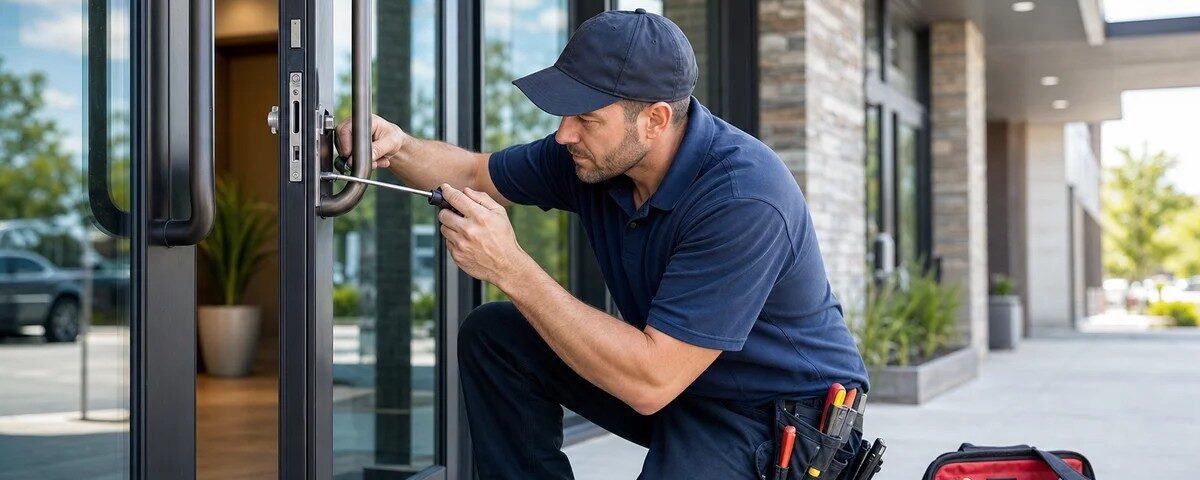
What commercial entry door repair covers
Commercial entry door repair is the service we use when a business door no longer opens, closes, latches, or locks the way it should. In plain language, it means troubleshooting the door, finding the weak point, and restoring safe operation for daily traffic. Managers usually notice the first signs before the door fails completely, such as dragging at the threshold, slamming shut, loose hardware, broken panic hardware, or a slab that will not stay aligned.
Even a small issue can create a bigger problem fast. A door that does not close cleanly can weaken security, trip up customers, slow deliveries, and interrupt the normal flow in and out of the building.
The hardware problems behind a storefront door failure
Most storefront entry door repair calls start with a few familiar parts. Commercial door hardware like hinges, pivots, closers, latches, strikes, handles, panic bars, and weatherstripping all take repeated use, and each one gives a clue when it starts to fail. A bent hinge pin can show up as a door that scrapes the floor. A weak closer often shows up as a door that slams or will not shut fully. A latch problem usually means the door meets the frame but never catches cleanly.
Impact, constant traffic, building vibration, and a poor previous install can push the whole opening out of alignment. If the door rubs one side, gaps change from top to bottom, or the handle feels loose every time it is used, those are strong signs that the opening needs attention before the problem spreads to the frame.
When hinges, closers, and latches need attention
Hinge or pivot trouble often shows up as rubbing at the floor, sagging on the latch side, or a door that drifts open or shut on its own. A bad closer can cause slamming or refusal to close, while latch issues show up when the bolt or latch does not engage the strike. Tightening may help a loose mount, but worn parts or a damaged frame usually need more than an adjustment.
Panic bars, locks, and handles that stick
Exit hardware can fail by binding, misfiring, or not releasing cleanly during normal use. We test life-safety hardware so the bar releases with normal pressure and the latch clears the strike without sticking. That helps the door work for everyday traffic and for exit use when it matters.
Frames, glass, and seals after impact or wear
Cracked glazing, bent frames, and torn seals often follow a collision, forced entry, or long-term settling. Those problems bring drafts, water intrusion, rattling, and a door that never lines up cleanly, which is why storefront entry door repair often includes more than just one broken part.
How a technician decides what can be fixed on site
A proper service visit starts with a walk-through that checks how the slab swings, where it binds, and whether the latch meets the strike. Then we decide whether the door can be adjusted, reseated, or re-hung, or whether a damaged component needs to be replaced.
- Test the door from both sides and note where it binds, drags, or slams.
- Inspect hardware wear, clearances, and frame movement at the top, latch side, and threshold.
- Decide whether the fix is an adjustment, a parts swap, or a larger repair that restores safe operation without overworking the door.
If you are comparing providers, we offer free estimates so the scope is clear before work starts, and our team can explain whether the opening is a repair candidate or needs full replacement.
What gets checked during the first walk-through
The tech should test the door from both sides, inspect hardware wear, and check clearances at the top, latch side, and threshold. One concrete checkpoint is whether the latch fully catches, because a door that closes but does not latch is still a security problem. We also watch closer speed, since a door that slams usually points to a control issue rather than a simple alignment problem.
What can usually be adjusted instead of replaced
Re-tightening hardware, replacing a closer, re-aligning the strike, or swapping worn weather seals can often solve the problem. Those adjustments work best when the slab and frame are still square, not badly bent, and not split at the mounting points.
Repair or replacement on a commercial entry door
The decision usually comes down to whether the slab, frame, and hardware are still sound enough for a stable repair. Repair is usually the better choice when the door and frame are sound, the problem is isolated, and the hardware still has a solid base to work from. Replacement makes more sense when the slab is bent, cracked, rotted, or repeatedly failing after earlier fixes, and a door replacement will solve the underlying problem.
| Factor | Repair | Replacement |
|---|---|---|
| Downtime | Usually limited to one opening and the affected hardware | Usually longer because the slab, frame, or glass may all need work |
| Cost | Usually lower when the problem is isolated | Usually higher because more parts and labor are involved |
| Safety risk | Works best when the frame and slab are still sound | Better when damage affects the structure or glazing |
| Expected result | Fixes the failed component and nearby adjustments | Resets the whole opening when wear is widespread |
A proper diagnosis helps avoid replacing parts that do not solve the underlying fit issue. The goal is to restore the opening once, not keep putting new parts on a door that cannot support them.
When repair is usually the smarter move
Repair fits doors with isolated problems like worn closers, loose hinges, bad seals, or a single broken piece of hardware. A good repair should restore normal operation without changing the door’s overall fit or forcing a full rebuild of the opening.
When replacement is the better call
Replacement is usually the cleaner choice when the slab is warped, the frame is compromised, the glass is unsafe, or the door keeps failing after earlier repairs. If the hardware cannot overcome underlying structural damage, more adjustment will not solve the root problem.
Questions owners ask before scheduling commercial entry door repair
These quick checks help managers decide whether to call now, wait, or prep the entrance before service. For business entry door repair, the best answers are the ones that point to a clear next step.
When is a door issue a safety problem instead of a minor nuisance?
It is a safety problem when the door will not latch, will not close, or interferes with emergency exit hardware. A panic bar that does not release cleanly, or a door that swings shut too hard, should be treated as urgent.
Can a storefront door be fixed without shutting down the business?
Yes, many repair calls can be handled during open hours if we can work from the exterior or isolate the entrance. That is especially true when only one entrance is affected and the hardware is accessible without removing the whole assembly.
What would make a commercial door service call turn into replacement?
Replacement is usually triggered by a bent frame, severe slab damage, repeated failure after prior repairs, or unsafe glazing. A frame that no longer holds the latch side square is a common example.
What should I tell the contractor before they arrive?
Tell us the symptom, note any impact or break-in, share the door type, and say whether the door is the only public entrance. It also helps to mention the lock brand, panic hardware type, or whether the issue happens only in hot or windy weather.
Get the entrance back to normal
If your door is dragging, slamming, or failing to latch, the best next step is to get the cause checked before the problem grows. For commercial entry door repair that starts with a clear diagnosis and a free estimate, contact us and let our team take a look at the opening.